SeaGL 2025 Absolutely Rocked
I attended SeaGL, the Seattle GNU/Linux conference, this year. It ran on Nov 7th and 8th of 2025. This blogpost is a retrospective / review of this year's conference. I've been to SeaGL many times before, and I've even contributed some volunteer labor to the event in the past. This year's conference was the best SeaGL that I've ever been to, and quite likely the best FOSS-focused conference that I've ever been to. This SeaGL has planted more seeds in my mind for future conference talks and blogposts and fun projects than any other conference I've been to.
I had a great time and I look forward to next year's SeaGL. I hope that the conference is able to garner some sponsors for next year's event so that they can continue operating into the future. As I understand it, they are extremely broke and while the software might be Free, UW is expensive.
My Talk
I spoke at SeaGL this year. This was my third time speaking at SeaGL and my sixth time speaking at conferences overall. This presentation was a bit of a "homecoming" for me, since SeaGL was the first (and second) conference that I ever spoke at. I spoke on the subject of software (im)mortality with a talk titled What Is Free May Never Die. A recording is available here.
The core idea of my presentation was that Free software doesn't die. When the forces of society conspire to kill software, they are only able to kill proprietary software. They can't kill Free software. I explain this idea much more fully in the recording, so I recommend watching that. If you don't have time to watch a 20 minute video, you can also just read the whole script here and look at the slides here. I tried to write it so that the slides weren't 100% necessary to get the point, and I think that I did a good job on this front.
Goals Of My Presentation
The core idea popped into my head while I was in the shower one day. In our popular culture it is common to take these types of ideas from the shower and plaster them on social media for instant gratification. I see these kinds of ideas as seeds, and posting them online is a form of eating the seeds. Instead of eating the seeds directly, I like to filter them into seed packets in my seed vault (text files in my personal wiki). Once I have enough seeds in a packet, I sow them, water them, tend to them, and harvest the fruit. This presentation was the fruit. By doing it this way, I'm able to eat the fruit (way more satisfying and tasty than the seed) and create more seeds. The main goal of this talk was to get the core idea out of my brain and plant seeds in the brains of others, where they might water them and grow them into fruit. I think that the framework that I presented in my talk might be practically useful in helping to motivate other people to write and maintain Free software. It might even be helpful in driving people to use Free software, but I'm not as sure about that. Only time will tell if I was successful in this primary goal.
I also wanted to give this non-technical talk to expand my capabilities and repertoire in speaking. I had previously only spoken about technical (or historical) topics, which are relatively easy to speak about. For those types of talks, you're just standing in the front of a room repeating things that are verifiably true. People can disagree with your presentation style and your stated values and all sorts of things, but the skeleton of your talk (the raw facts) are raw facts no matter how you slice them. This was a more "philosophical" talk, and I had quite a difficult time writing it. I did lean heavily on historical facts for a good portion of my talk, but these were provided solely to back up the factuality of the core idea, something that can't be arrived at by purely technical operations. In this sense my talk was successful because I did a fairly good job on it.
Missing The Mark
My talk wasn't perfect (no presentation is). There were things that I could have done better.
- Comparing the script that I wrote to the actual words that I said in the recording, I missed a couple of spots that I thought would be impactful. More rehearsals (I did 15) would help with this.
- People didn't know instinctively when the "time for applause" was because I didn't build to it properly. I needed to build the anticipation towards climax better. I did a really good job of this in my LibrePlanet 2024 talk.
- I went over time. I knew that this would happen because I had a 20 minute slot and my practice runs kept coming out to slighty more than 20 minutes. I even cleared this up with the conference organizers beforehand and was told that it wouldn't be a problem for me to go over slightly (I anticipated 45 seconds to 2 minutes). However, I forgot to mention this to my room proctor, who proceeded to rush me off stage as soon as my time was up. This was a shortfall on my part: it was my responsibility to make this clear before I started the presentation.
The Feedback
The reception on this presentation was the best that I have ever had for a conference talk. People came up to me throughout the conference and during both after parties to say how much they liked it. The feedback that I can recall now as:
- It was like a YouTube video essay (I think that this was intended as a compliment but it could have been an underhanded diss)
- It was like a long Ted talk
- Your timing was impeccable, you knew your slides so well
- I felt moved and touched
- I tuned in to only part of your talk and was blown away
- I tuned into your talk from another simultaneous talk and listened only to the audio, then recognized your voice from across the room at a loud after-party and came to thank you
- This makes me feel bad about spending my professional life writing proprietary software
One of the pieces of software that I list as "dormant, waiting for someone to come pick it up" in my talk was BitKeeper. Toby Betts, the guy who talks about Temple OS, mentioned that he is actually the guy who is carrying the torch on BitKeeper. He compiled it and uses it personally because he doesn't like Git. This beautifully underlines my core point.
Some people also raised questions about the core idea (which is what I wanted).
What are the implications of AI on this?
My gut reaction was that AI doesn't have much to do about whether or not software can or does die. I personally view AI as a benefit to Free software. Proprietary software developers have a profit motive to use AI, and it produces a lower quality product (slop, vibe code), which is rough around the edges and has weird bugs. This helps to lower proprietary software's quality of work to what Free software users are accustomed to from Free software. Levelling the playing field like this works in our benefit.
I figured that there is some impact on software's longevity by being scooped up by an LLM. If you don't care about getting rich or getting recognition, then LLMs help to propogate your ideas. By copying your work and repeating it to other people, the pattern of symbols produced by your brain are further advanced into the future. This is a huge benefit if your primary goal is that your work become widely used (and immortalized).
The person who raised this question, however, works at Microsoft on an open-source project called Amplifier. He mentioned that their current private development work (to be publicly available Soon™) is able to produce high-quality and complex software based on a description of what the software should accomplish. I even talked with him about being able to do it all local and offline so that there is no reliance on the big dogs of "AI". He said that that was his current project. If this really is possible and becomes generally available, then it will drastically lower the bar for the general public to write their own software for their own personal needs. The ability to do this will change the landscape, as people won't need to purchase proprietary software in order to accomplish their goals in the future, they'll just describe it. It's possible that in the future, the vast majority of software that people use is personal software. If this happens, then I suspect the intrinsic human nature to share and want to be shared will take hold and we'll see a proliferation of Free software. Perhaps that's wishful thinking.
What if nobody has a copy?
One person asked this question about Free software's longevity. If Alice writes a piece of Free software and distributes it to Bob and Eve, and then all three of them die and their disks are encrypted and nobody else can ever get a copy, then yes the Free software is effectively dead, not dormant. This underlines how important it is to share your software with the general public if you want it to last.
The Followup
I think that there is more to be explored here, and I intend to if I ever speak on this topic in the future. Some of these expanded topics are:
- What if the government makes Free software illegal?
- Does the amount of software really matter? It seems like the amount of software that people use is more important.
- Proprietary software being taken away form the users is a bigger problem than I initially highlighted. This is a real thing that is happening more and more often. Software hasn't been in popular use for long enough for the general population to have seen this happen enough and care.
- What type of software is most like a handaxe/calculus?
Other Talks
I saw several other talks during the conference this year. There were some that I wanted to see but didn't get to either because I was engaged in discussions with people or because there were multiple talks that I wanted to see going on at the same time. Here are some thoughts on a select small number of the talks that I saw.
Fediverse Keynote
The opening talk of the entire conference was about the Fediverse, given by Evan Prodromou. Evan previously wrote a book specifically about programming for ActivityPub. I found his talk intriguing and he raised some interesting points.
The thing that stuck with me the most from Evan's talk was when he described the history of the blogosphere and went on to say that modern post-social-media attempts to return to such a setup are impotent nostalgia. He said that the past seems better but that it wasn't, and he said that it seems like we can return to it but we can't. For obvious reasons, this led me to cast a critical gaze at my own blog. I don't have any social media accounts, and I maintain this website as my primary public-facing persona. Am I suffering from nostalgia, trying in futility to return to a past that was worse (and I didn't even directly experience)?
I've looked at the possibility of making these blogposts available over ActivityPub in the past, but I've run into some interesting issues with doing so. First and foremost, this is a static website generated using an SSG that I cobbled together. Since ActivityPub is by its very nature a participatory technology, I would have to completely rewrite my website and learn new tools to do so. The real enticing factor that even makes me look in this direction is that syndicating this content on ActivityPub might make it more accessible for some people. I already have an RSS feed for these posts, but having them show up in a social-media-like interface that people are familiar with might help them get read. If more people read my blog then that counts as a "win" for me, and the Venn Diagram of people who use the fediverse and who use feed readers is not a circle.
There is an additional problem posed by the formatting of my blog. For the most part these posts are a lot of text in HTML with an image here or there. However there are also posts that have a huge number of images in image galleries. I don't know of any ActivityPub implementations that can support the way that I write these blogs.
Thankfully, I had the opportunity to talk with Evan about my specific blog and implementing it on the Fediverse at Friday's SeaGL after-party. He assured me that huge amounts of HTML text with images interspersed is not a problem at all for the fediverse and is in fact well-supported. The only issue for my blog is the fancy image galleries. One way around this limitation would be to have each gallery with text be a separate post. I think that this is a reasonable method to structure things. An alternative would be to use one of the many available RSS -> Fediverse bridges that exist on the public Internet.
Maybe I will eventually syndicate this blog's content on the fediverse. If I do, I'll wind up hosting my own server, since I can't ever seem to find a stable one hosted by others with a ToS that I can honestly agree to. It's the same reason that I run my own blog instead of using something like bearblog and my own Matrix server instead of using the default matrix.org one. Content policies are a slippery slope and I've seen them abused too many times to trust them with my free expression of thoughts. A smart man learns from his mistakes, but a wise man learns from the mistakes of others.
Local Offline AI
Adam Monsen gave a talk about running AI models on local hardware and I found it highly educational. It was an effective quick rundown of the local model landscape. I expect to replicate some of his successes going forward on my own hardware and I may even post about them on this blog.
James's Presentation
James Sundquist gave a presentation titled Physical Theatre, made using open source tooling. I've known James since LFNW 2025 and I've followed his podcast online since then as well. I'm not sure what James's talk had to do with Free software. He mentioned an open source script-writing application early in the presentation and then later made an off-handed comment that one of his props was open hardware. Other than that, his presentation was a theatre performance, not a tech talk.
It rocked.
I loved it. My girlfriend with me loved it. Everyone in the room loved it. It was a hilarious, engaging, wide-ranging tour of fun. James performed portions of his original stage works, all of which were originally written for groups but had been adapted for performance by one man. You don't notice that there is only one guy on stage. James had the energy and explosion of a whole crew. I will happily see any performance that he gives over any intriguing technical topic. I hope that we are never scheduled to speak at the same time.
If you ever have the opportunity to see James perform at a conference or in-person under the name Living Cartoon Company, I strongly encourage you to do so. He doesn't disappoint.
Keysigning
In the days leading up to SeaGL, discussions in the Matrix chatrooms led some people to want to engage in a GPG keysigning party. We planned it all out ahead of time, and it went pretty well. There were a few hiccups here and there, but we managed to get everything sorted out.
I produced a page on my website to prove that I am the same guy in person (people could compare my picture to my face in real life), printed out copies of my key, and even made digital copies on cheapo disposable laser-engraved flash drives. Other people brought their keys on paper (printed or hand-written) or pointed others to their websites or other keyservers to find their keys. We verified each other through a number of means, ranging from attested proofs like mine to government-issued ID, to recognizable people.
One thing that we all did after signing each other's keys was encrypt the signatures and send them back to each other. This was an effective way to prove that people did in fact have control of the corresponding private key.
The keysigning party was a lot of fun and I got my GPG key signed by five people (with hopefully a sixth to come Soon™). I signed the keys of:
- Morgan from mcmillian.dev
- Trevor from johnsonfarms.us
- Ted Matsumura from the LPI
- Adam Monsen, the aforementioned speaker and SeaGL cofounder
- Matt from comp.uter.science
- Edward Ly the software engineer and DDR chart artist
I expect to write a more detailed writeup of keysigning parties in the future, and I may even speak on the topic at conferences going forward. It was a really good time.
Element
I also engaged in Matrix keysigning with a few people. Matrix encrypts messages E2E and so runs into the same "is this really that person's key?" issue that GPG runs into. With Element X, the modern mobile client, some of us were able to able to verify each others' keys. There was a little bit of tomfoolery in that you have to click a surprising number of times to find the button on someone's profile to verify them, and it takes an unreasonable amount of time to load. Additionally, one person using legacy Element mobile (not the X variety) was unable to participate in this signing since that version expects a QR code instead of emoji comparison.
Element's keysigning was clunky and slow and unintuitive. I hope that it improves in the future. Admittedly GPG keysigning was clunkier and slower and less intuitive, but at least people expected that and were prepared for it. Chat applications have trained people to expect things instantly, and that expectation was not met with the key verification.
Social Events
SeaGL had a large number of social events outside of the main conference this year and they all rocked. Everyone was friendly and sociable and I had a great time at everything. What follows are some notes from a few of these events (though not all).
After-parties
The Friday after-party was at Ada's Technical Books in Capital Hill. They have a rentable bar attached to the bookstore which SeaGL rented out. Here I talked with a handful of people from the conference on a wide range of topics. This is where an attendee recognized my voice from across the room and where I talked with Evan about ActivityPub for this blog. At one point early in the party, I saw two dudes sitting against the wall alone, not talking to anyone or engaging with anything. I struck up a conversation with them and I'm glad I did. I got to meet new people and make new friends.
One of these people was Edward (aforementioned keysigning party attendee). He's a really cool dude and I look forward to talking with him and meeting him at future conferences. I also met a guy named Wade who was from Florida, up at UW for an space exploration meeting. He stumbled upon SeaGL and just thought that the people seemed friendly. Only at the after-party did he find out that it's actually a real conference. Hearing Wade's life story was amazing, and I'm glad that I struck up conversation with him. I hope that he had a great rest of his time in Seattle, and I'm sad that I didn't get his contact information to keep in touch.
I also bought a book at Ada's during the Friday after-party. The book is Game Boy Coding Adventure. Long-time readers of this blog who read the Personal History section of my STK blogpost will see this as harkening back to some early childhood memories. I'm excited to work through this book, and I may wind up creating something worth posting on this blog in the future. I bought this book at the after-party instead of during the conference because I didn't want to carry it around all day. I'm happy to patronize the sponsors of SeaGL, I just hope that it shows up in their numbers as a SeaGL-related sale.
The Saturday after-party was at Big Time Brewery in the U-District. This party likewise resulted in some fun and engaging conversations with other conference-goers. We got to compare all three form-factors of Framework Laptops (12, 13, and 16), I met a bread delivery driver who is working on his own open source game inventory management project, and I had some onion rings that were actually made correctly (most onion rings are undercooked and result in a poor eating experience). Big Time is always a nice place, and their food is surprisingly good for a bar.
TeaGL
There is a lot of overlap between people who are extremely particular about their computers and people who are extremely particular about their hot beverages. As a result there is a sizeable population of SeaGL participants who love to drink tea. So there is an event that happens during SeaGL called TeaGL. It is run by Robin, a self-described "tea maid" from somewhere in the desert lands. She makes a wonderful tea to-order in the Chinese tea ceremony style, and I love it.
This year featured the return of the TeaGL tea swap. Attendees could sign up beforehand to be partnered with a random TeaGL Buddy with whom they would trade teas during the conference. Me and my gf got assigned each other, and we received the emails while sitting on the couch right next to each other. We laughed about it a bit and then I emailed Linnea, the officiant for the TeaGL tea swap, about the issue. Linnea re-partenred us with new people (herself and Ammar, who I later learned was voluntold to be my Buddy).
Ammar put down that he usually drinks bagged tea and that he likes hibiscus. I went to the local health foods shop and bought loose leaf jasmine and hibiscus leaves, then mixed them together in a glass jar. Since this was loose leaf and he mentioned usually drinking bagged, I didn't know if he had an infuser so I also got him an infuser. I thought that I had done pretty good, Ammar did in fact not have an infuser (his had broken) and it turns out that he loves the tea :)
However, Ammar won TeaGL 2025. He knocked it out of the park, into the next park over, and resulted in 4 home runs in each park. To start, he 3D-printed (in a plant-safe material) a container for holding tea. The symbol on the front is the Chinese symbol for tea.
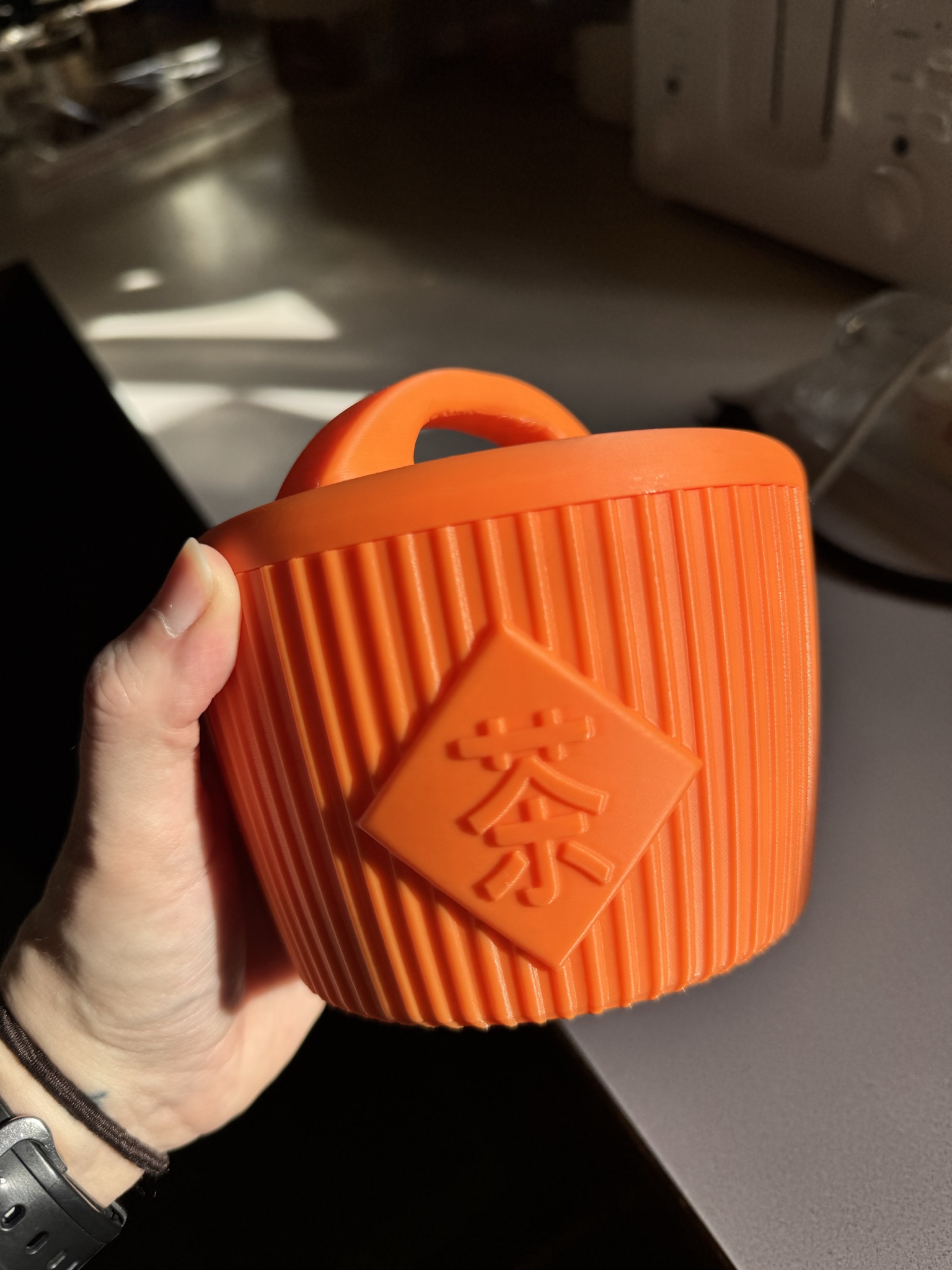
Inside is a herbal tea mixture of mint, thyme, and basil that he grew himself hydroponically.
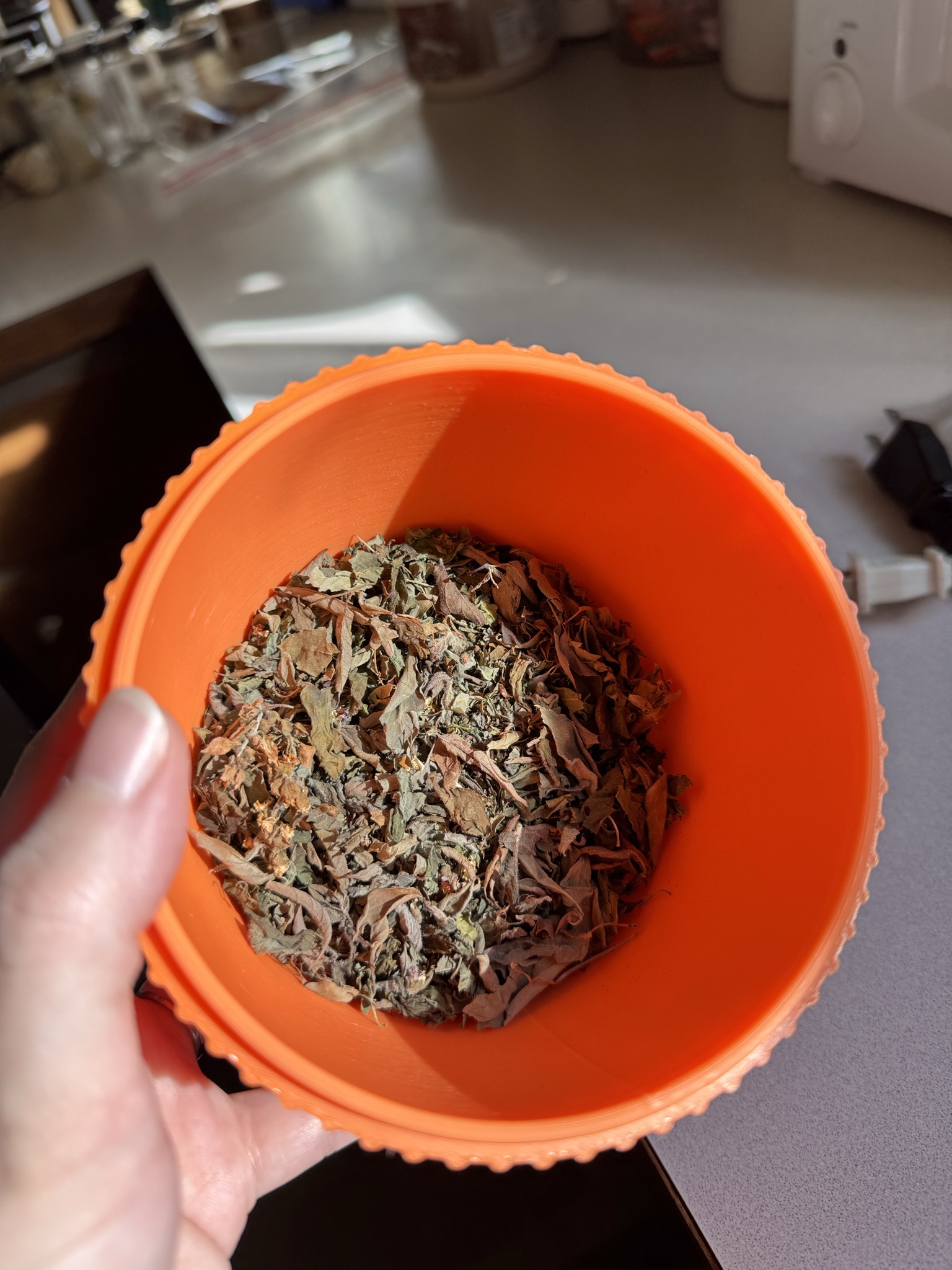
I am amazed. Flabbergasted. Shocked. I feel like a spoiled boy on Christmas morning. This stuff is delicious. It's not "technically" tea, but who cares? It rocks, it clears out my sinuses and it is tasty. I feel like when I won the grand prize for the LFNW raffle one year.
The GF Report
My girlfriend accompanies me to all sorts of nerd conferences, she's been to five of them now, and this SeaGL was her favorite as well. I'll let her speak in her own words:
I thought everyone was really nice and I liked James's performance. I really liked the focus on moving people away from tech monopolies. A lot of it felt very newbie-welcoming. More so than any other conference I've been to. It felt like someone who didn't know anything could have these conversations about stuff easier. It felt more accessible than other conferences as someone who isn't an expert. Since I've been to a few in the area now, I've made friends, and it's easier to have these conversations with friends.
Findings
SeaGL is a great conference to attend. This is regardless of whether or not you're an expert or brand new to the scene. It would be a wonderful conference to sponsor. If I had a tech company, I would want to sponsor SeaGL to get my name in front of people at all stages of their career or adventure in open source.
Coverage From Around The Net
Ted Matsumura wrote a post about SeaGL as well, which you can find here (archive).
Trevor wrote up a blogpost about his cool badge that he wore to the PGP party. You can find it here (archive).
Adam's notes on his local offline AI talk can be found here (archive).